
Change Management and Risk Management (A Perfect Match?)
Change is constant, and managing it well separates successful organisations from the ones that keep putting out fires.
I usually default to ISO 31000, the international standard for risk management, as a framework for positioning change, especially when it comes to supporting service and asset lifecycles.
Most people associate ISO 31000 with traditional risk management, such as safety, compliance breaches, financial issues, etc., but in my experience, it’s just as powerful when used to frame and guide organisational change.
Why? Because change is a risk, it introduces uncertainty. But it’s also an opportunity, if we manage it properly.
When an organisation changes its operations, systems, or even culture to manage assets better, it needs to assess what could go wrong and what could go right.
Change = Risk (and Opportunity)
ISO 31000 aligns nicely with asset management because both disciplines are built around balancing cost, risk, and performance. When change initiatives are evaluated through that lens, decision-making becomes more informed and intentional. Vertically through the organisation and horizontally across the service and asset lifecycles.
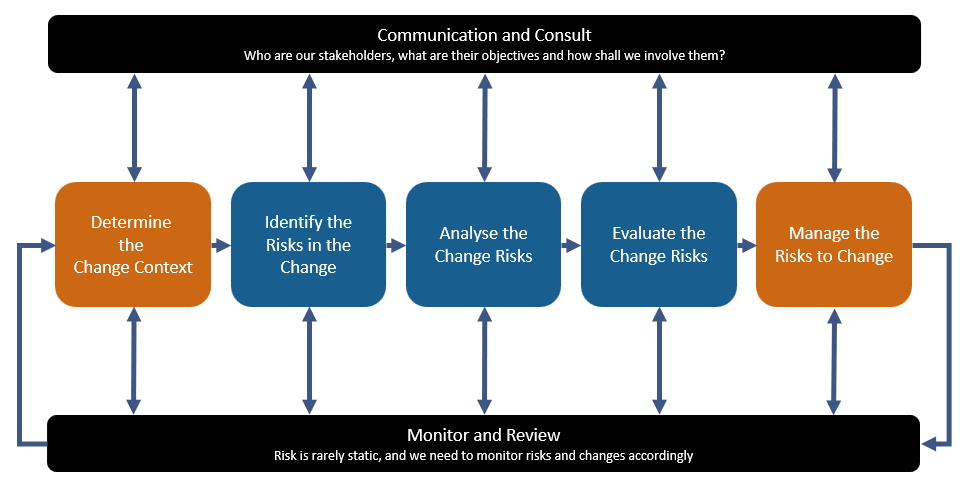
ISO 31000 Alignment to Change
-
Determining the change Context: I start by understanding the internal and external pressures behind the change. This includes stakeholder expectations, lifecycle phase, and strategic objectives (e.g., as outlined in the SAMP).
-
Identify Risks in the Change: What could disrupt the change? Resistance, capability gaps, or legacy systems?
-
Analyse the Change Risks: I evaluate the likelihood and impact of each risk (positive or negative). Not every risk is a showstopper; some are worth taking.
-
Evaluate the Change Risks: This is where I design mitigation plans, communication strategies, and contingency buffers.
-
Manage the Risks to Change: Important, keep a change risk register that looks at the risks on the journey to value, not just risks to the value itself (two different perspectives)
-
Monitor and Review: Change isn’t “set and forget.” I use lead indicators (ahead of lag indicators) and adjust as new risks emerge or old ones evolve.
-
Communication and Consultation: This starts at the beginning and continues beyond the end of the initiative or lifecycle.
This structured approach doesn’t just reduce disruption, it builds confidence. And that’s gold when you’re dealing with stakeholders across operations, finance, engineering, or the executive team.
One of the most important shifts I’ve seen is treating risk as a two-sided coin. Yes, we need to prevent failure. However, we also need to spot the possibility of improving, simplifying, automating, or even innovating how we manage assets.
I’ve used ISO 31000 to support everything from rolling out digital asset systems to restructuring maintenance strategies. And every time, it’s helped align the change effort with broader business goals because it’s built on good governance and informed decision making.
If you’re working in asset management and trying to implement change, whether it’s a new system, a process update, or a culture shift, don’t overlook ISO 31000. It’s not just for the risk manager, and it’s a powerful change management tool.
Change and risk aren’t separate…They are intertwined. And when we manage them together, we deliver real, lasting value across the lifecycle.
#ChangeManagement #RiskManagement #ISO31000 #AssetManagement #OrganisationalChange #ServiceLifecycle #AssetLifecycle #StrategicChange #Governance #Resilience #OpportunityManagement #RiskAndOpportunity #SAMP #OperationalExcellence #LeadershipInChange #DigitalAssetManagement #MaintenanceStrategy #LifecycleValue #StakeholderEngagement #InformedDecisions #BusinessAlignment #ChangeIsRisk #TransformWithConfidence