An Organisational Change Management delivery solution specifically designed to Implement & Embed Asset Management
The Structured Change Implementation Framework (SCIF) integrates ISO 10020 Organisational Change Management, ISO 55001 Asset Management and practical implementation tools into a complete solution that helps organisations realise, adopt and sustain change.
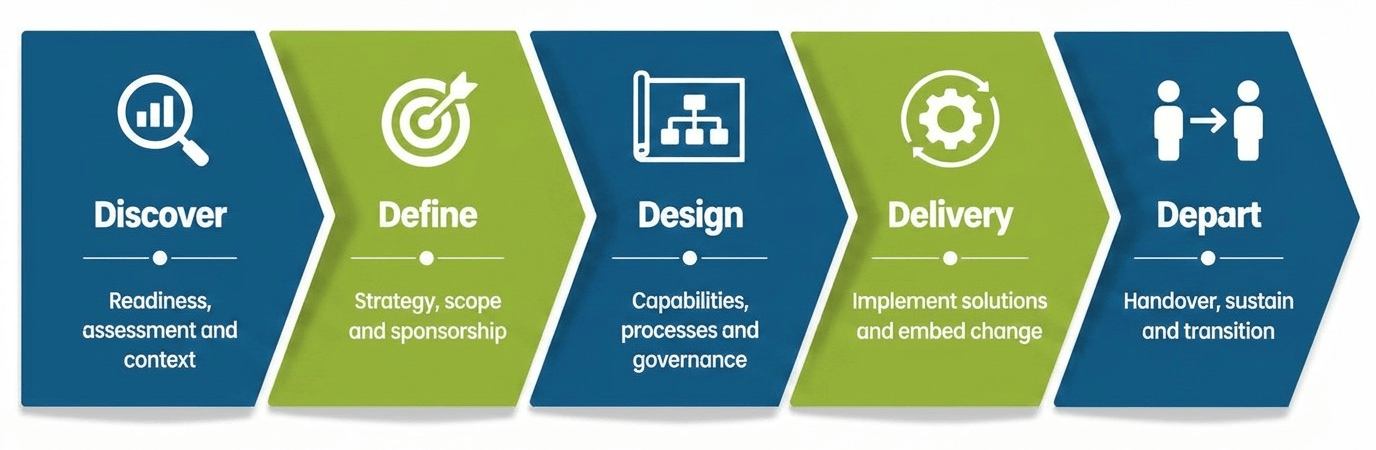
A Practical Roadmap from Change to Capability
The five phases create a complete lifecycle: from understanding the need for change through to transferring ownership and sustaining outcomes long after the engagement concludes.
Each phase is governed by defined exit criteria, ensuring no phase is complete until the required outputs have been produced and validated.
The problem is rarely technical. It is almost always human.
Most Asset Management initiatives invest heavily in systems, processes and technical compliance, yet adoption remains stubbornly low.
Organisations spend years implementing sophisticated platforms only to find the workforce has not changed how it works, leadership has not committed to new ways of governing, and the expected benefits remain unrealised.
The reality: Most Asset Management initiatives focus on technical compliance. Few focus on organisational adoption. SCF was specifically developed to solve this problem.
Introducing the SCIF
One Framework. One Solution. Sustainable Change.
The Structured Change Delivery Framework is a purpose-built methodology for asset-intensive organisations that need to move beyond compliance and achieve genuine, lasting change. It combines ISO 10020 with ISO 55001 to create a coherent pathway from strategy to sustainability.
The Integration of Governance
- ISO 10020 Organisational Change Management
- ISO 55001 Asset Management
- ISO 10007 Configuration Management
- ISO 44001 Collaborative Business Relationships
- Governance, assurance and benefits realisation
- Competency development and sustainable handover
The Importance of SCIF Supporting Stakeholder Groups
Organisational change does not succeed through project delivery alone. Sustainable value is realised when strategy, investment, assets, people, processes, technology and operational capability are aligned, and the organisation is ready and able to adopt, operate and sustain what has been delivered.
The Structured Change Implementation Framework (SCIF) provides a common management framework connecting these dimensions. It brings together Asset Management and Change Management perspectives, recognising that delivering an asset, system, process or capability is only part of the value equation. The organisation must also develop the leadership, stakeholder commitment, behaviours, knowledge and capability required to realise its intended value.
SCIF creates value differently for each stakeholder. Boards seek assurance, executives seek strategic execution and value realisation, Program and Project Leads seek integration and delivery confidence, Change Leads seek readiness and adoption, Analysts seek traceability and decision-quality information, and Operations and Asset Owners seek sustainable operational value.
The following perspectives show how SCIF provides a common thread across these stakeholder groups, connecting strategic intent, delivery, organisational readiness, implementation, and sustained value while supporting each stakeholder’s responsibilities and decisions.
Stakeholder Benefits
The Organisation
Primary concern: Are we consistently converting investment and organisational change into sustainable enterprise value?
- Connects strategy, assets, people, processes, technology and change within a common management structure.
- Creates enterprise-wide line-of-sight from strategic objectives to delivered and sustained outcomes.
- Improves whole-of-lifecycle thinking rather than optimising only for project delivery.
- Reduces fragmentation between Asset Management, Change, Projects, Programs and Operations.
- Establishes repeatable organisational change capability rather than dependence on individual practitioners.
- Improves visibility of enterprise risk, readiness, dependencies, capability and benefits.
- Creates reusable organisational knowledge and evidence instead of losing it when projects close.
- Enables the SCIF to become a structured operational information layer that supports enterprise governance and reporting.
The SCIF helps the organisation systematically convert strategy and investment into sustainable organisational and asset value.
The Board
Primary concern: Do we have sufficient assurance that major change and investment are controlled and can deliver sustainable value?
- Provides structured assurance over organisational and operational readiness.
- Creates traceability from strategic intent through investment, implementation and outcomes.
- Makes significant change, asset, stakeholder, capability and implementation risks more visible.
- Clarifies ownership and accountability for benefits and operational outcomes.
- Provides evidence that the organisation can operate, support and sustain what is being implemented.
- Strengthens governance gates through defined readiness criteria and evidence.
- Improves visibility of dependencies and systemic risks that can cross project boundaries.
- Creates a more auditable evidence base through structured SCIF information and governance.
The SCIF strengthens Board assurance that organisational investment is governed, risks are visible, readiness is evidenced, and value can be sustained.
CEO & Executive
Primary concern: Are our strategic investments actually producing the organisational outcomes we intended?
- Provides line of sight from strategy and investment through execution to operational outcomes.
- Shows whether the organisation is ready to realise value from new or changed assets and capabilities.
- Distinguishes delivery completion from successful organisational implementation and value realisation.
- Exposes significant readiness, stakeholder, capability, asset and operational risks earlier.
- Connects executive decisions with accountable owners, actions, milestones and outcomes.
- Improves visibility across programs rather than relying on isolated project reporting.
- Supports decisions based on structured evidence rather than predominantly narrative status reports.
- Provides a foundation for increasingly integrated executive reporting through SCIF data and insights.
The SCIF gives executives greater confidence that strategic intent is becoming operational capability and measurable value.
Program Lead
Primary concern: Are multiple projects and change streams collectively creating the intended program outcome?
- Connects individual projects to program outcomes and organisational objectives.
- Integrates dependencies across asset, technical, organisational, and people change.
- Provides visibility of cumulative change impacts across multiple initiatives.
- Identifies where one project’s delivery or readiness affects another.
- Supports integrated management of milestones, risks, readiness, stakeholders and benefits.
- Helps coordinate business capability development with technical/asset implementation.
- Creates consistent information across constituent projects rather than incompatible reporting approaches.
- Enables SCIF to aggregate structured project/change information into a coherent program view.
The SCIF helps Program Leads manage the integrated system of projects, assets, people and organisational change required to achieve program outcomes.
Project Lead
Primary concern: Can we deliver successfully and leave the organisation able to use and sustain what we deliver?
- Integrates solution/asset readiness with organisational readiness.
- Identifies people, process, information, technology and operational impacts alongside technical delivery.
- Makes change activities visible within the overall project delivery environment.
- Identifies readiness gaps before implementation, not after go-live.
- Connects stakeholder commitments, training, communications, risks and implementation actions to delivery.
- Strengthens handover by establishing operational ownership, capability and support requirements.
- Keeps attention on benefits and operational outcomes, not just project completion.
- Uses SCIF to connect delivery work with change work, dependencies, evidence and accountability.
The SCIF helps Project Leads deliver not only a completed solution, but an organisation ready and capable of using it successfully.
Change Lead
Primary concern: How do I systematically manage organisational change and demonstrate that my work contributes to business outcomes?
- Provides a structured Discover, Define, Design, Deliver and Depart lifecycle for managing change.
- Connects Change Management directly to project, program, asset and operational outcomes.
- Provides structured approaches for stakeholder, impact, readiness, capability, communication and implementation management.
- Strengthens the relationship between adoption and actual value realisation.
- Moves Change Management beyond communications and training toward organisational readiness and capability.
- Creates clearer evidence of change progress, risks, interventions and outcomes.
- Enables lessons and change knowledge to be retained and reused across initiatives.
The SCIF gives Change Leads a structured management system to turn organisational change expertise into measurable readiness, adoption, capability, and sustained value.
Change & Business Analyst
Primary concern: How do I convert analysis into reliable information that supports decisions and action?
- Provides structure for analysing impacts across people, process, technology, information, assets and operations.
- Connects analysis to strategic objectives, deliverables and expected outcomes.
- Creates traceability between findings, risks, stakeholders, decisions, actions and implementation.
- Reduces repeated collection and recreation of the same information across documents.
- Helps identify relationships and dependencies that might otherwise remain hidden.
- Creates consistent information that can be aggregated for project, program and enterprise reporting.
- Turns analysis into a persistent organisational information asset rather than a point-in-time document.
- SCIF provides structured work types, fields, and associations that make analysis actionable management information.
The SCIF helps Analysts turn fragmented analysis into structured, traceable and decision-ready organisational intelligence.
Business As Usual (Operations)
Primary concern: Are we inheriting something we can actually operate, support, maintain and derive value from?
- Involves operational and asset owners before project closure rather than treating BAU as the final recipient.
- Establishes clear ownership of assets, processes, capabilities, risks and benefits.
- Ensures operational capability, competencies, support arrangements and knowledge are established before handover.
- Connects implementation decisions with downstream lifecycle and operational consequences.
- Improves transfer of project knowledge into persistent organisational knowledge.
- Helps prevent unresolved project risks and issues simply becoming BAU problems.
- Maintains focus on asset performance, adoption, benefits and sustained value after implementation.
- Provides persistent SCIF records supporting traceability beyond formal project closure.
The SCIF helps Operations inherit an operational capability, not simply a completed project, and sustain the intended value throughout its lifecycle.
The Structured Change Implementation Framework (SCIF)
An Organisational Change Management delivery solution specifically designed to implement and embed Asset Management.
Transforming Asset Management requires more than systems and processes,
it requires people, leadership, governance and capability!
#SCIF #StructuredChange #ChangeManagement #AssetManagement #OrganisationalChange #Transformation #ChangeLeadership #StrategicExecution #ValueRealisation #BusinessReadiness #BenefitsRealisation #ProjectManagement #ProgramManagement #Governance #OrganisationalCapability #ISO55001 #ISO10020