
Why the Future of Asset-Intensive Organisations Depends on Learning, Not Just Assets
(This article is my personal view and one that I came across as a change practitioner – I hope you get something from it)
For decades, Maintenance, Reliability and Asset Management have been treated as distinct disciplines.
Maintenance professionals focus on keeping equipment operating. Reliability professionals focus on understanding and preventing failure. Asset Management professionals focus on balancing cost, risk, performance and value across the lifecycle.
Each discipline has its own tools, methodologies, certifications and communities.
Yet after more than thirty years working across maintenance, reliability, organisational change and asset management, I have come to a different conclusion.
Maintenance, Reliability and Asset Management are not separate disciplines competing for organisational attention, and this could be a symptom of organisational maturity disguised through the alignment, or as we also refer to as “the coordinated activity of an organisation to realize value from assets
They are progressive levels of organisational learning and realisation of moving forward in that coordination.
As a change practitioner, I was always drawn to the “Triple-Loop Learning” model.
Triple-loop learning provides a powerful lens for organisational change management by moving beyond simply implementing change correctly (single-loop learning) or improving how change is delivered (double-loop learning) to questioning the underlying assumptions, beliefs, culture, and governance that drive organisational behaviour (triple-loop learning).
In practice, this means organisations not only ask “Are we doing things right?” and “Are we doing the right things?”, but also “How do we decide what is right?”. By embedding triple-loop learning throughout the change lifecycle, organisations can continuously adapt their strategies, leadership approaches, decision-making frameworks, and organisational culture, creating sustainable change that is aligned with long-term objectives, stakeholder needs, and evolving business environments.
Returning to my own roots, let us consider Maintenance, Reliability and Asset Management.
Viewed through this lens, Maintenance represents Single-Loop Learning, Reliability represents Double-Loop Learning, and Asset Management represents Triple-Loop Learning.
This perspective not only explains how organisations mature, but also why many organisations struggle to move beyond reactive operations despite investing heavily in maintenance systems, reliability programs and asset management frameworks.
My Journey from Maintenance to Reliability to Asset Management (and sometimes back again)
My career began as a Maintenance Fitter-Machinist in manufacturing and food processing environments.
Like many maintenance professionals, my focus was straightforward: keep assets operating safely and effectively.
Over time, I became increasingly interested in why assets failed and how to prevent those failures in the first place. This led me into Reliability Engineering, where I worked extensively with FMEA, FMECA, Reliability-Centred Maintenance (RCM), Root Cause Analysis, and failure-elimination methodologies.
The deeper I explored reliability, however, the more I recognised that asset performance was often influenced by decisions made long before maintenance activities occurred. Asset design, procurement strategies, operating philosophies, risk appetite, governance arrangements and investment decisions all influenced outcomes.
This eventually led me into Asset Management and, later, to my involvement with ISO 55001, the Global Forum on Maintenance and Asset Management (GFMAM), and the World Partners in Asset Management (WPIAM).
Reflecting on that journey, I often summarise it with a simple statement:
The better I understood Maintenance, the more I appreciated Reliability.
The better I understood Reliability, the more I appreciated Asset Management.
Understanding the Three Loops of Learning
Organisational learning theory describes three increasingly sophisticated levels of learning.
Single-Loop Learning
Single-loop learning asks: “Are we doing things correctly?”
The focus is on correcting deviations from expected performance.
When something goes wrong, action is taken to restore compliance or return the system to its intended state.
Double-Loop Learning
Double-loop learning asks: “Are we doing the right things?”
Rather than simply correcting errors, the organisation examines the assumptions, processes and decisions that led to the problem.
The focus shifts from fixing failures to preventing them.
Triple-Loop Learning
Triple-loop learning asks: “How do we decide what is right?”
At this level, the organisation examines the governance structures, decision-making frameworks, leadership behaviours, and organisational culture that shape decision-making.
The focus shifts to improving the system that makes the decisions.

This pyramid is not a hierarchy of importance. Maintenance is not less valuable than Asset Management. Rather, it is a hierarchy of organisational learning depth. The foundation is broad and operational; the apex is strategic and systemic. An organisation without excellent Maintenance cannot achieve genuine Reliability. An organisation without genuine Reliability cannot realise the full promise of Asset Management. The three levels are interdependent by design; however, a mature organisation would realise their interdependence.
Maintenance: The First Loop
Maintenance is often misunderstood as simply fixing equipment!
In reality, maintenance is a disciplined process designed to retain or restore assets to a condition in which they can perform their required functions. (and support organisational outcomes)
Typical maintenance activities include:
- Preventive maintenance
- Corrective maintenance
- Shutdown and outage management
- Work management
- Resource planning
- Contractor management
From a learning perspective, maintenance primarily operates within the first loop.
When an asset fails, maintenance responds by repairing, replacing or restoring the asset.
Performance is returned to the desired level.
The organisation asks:
“Are we doing things correctly?”
This focus on execution excellence is essential. Without effective maintenance, there is no foundation upon which reliability or asset management can be built.
However, maintenance alone rarely prevents future failures.
It simply restores the asset after a failure occurs.
Reliability: The Second Loop
Reliability introduces a different question.
Rather than asking how to restore performance, reliability asks why performance was lost in the first place. Root cause analysis comes into play
Reliability professionals seek to understand:
- Failure mechanisms
- Failure modes
- Root causes
- System interactions
- Defect generation
- Performance trends
Tools such as FMEA, FMECA, RCA and RCM help organisations challenge existing maintenance practices and identify opportunities to eliminate recurring failures.
The question becomes:
“Are we doing the right things?”
This is Double-Loop Learning.
Rather than fixing failures, reliability seeks to improve the decisions that influence asset performance.
This represents a significant step in organisational maturity because the focus shifts from reactive action to proactive improvement.
Yet even reliability has limitations.
Reliability improves decisions, but it typically operates within organisational objectives that have already been established.
It improves the game but does not necessarily question the rules of the game.
Asset Management: The Third Loop
Asset Management extends organisational thinking even further.
ISO 55000 defines Asset Management as: “The coordinated activity of an organisation to realise value from assets.”
This definition is fundamentally different from traditional maintenance and reliability objectives.
The focus is no longer solely on equipment performance.
The focus becomes value.
Value requires balancing:
- Cost
- Risk
- Performance
- Opportunity
- Sustainability
- Stakeholder expectations
This introduces a new question:
“How do we decide what is right?”
Asset Management therefore represents Triple-Loop Learning.
Rather than focusing exclusively on asset failures or maintenance strategies, organisations begin examining:
- Governance frameworks
- Investment decisions
- Lifecycle strategies
- Organisational objectives
- Leadership behaviours
- Decision-making processes
Asset Management challenges the assumptions behind organisational decisions and seeks to optimise value across the entire lifecycle.
This is why Asset Management cannot simply be implemented through a software system or a maintenance program.
It requires organisational transformation.
PDCA Exists Within Every Loop!
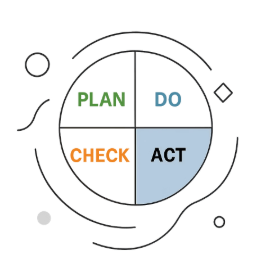
One of the most interesting observations is that the Plan-Do-Check-Act (PDCA) cycle operates within all three loops.
Maintenance PDCA
- Plan: Maintenance schedules and work plans
- Do: Execute maintenance activities
- Check: Verify completion and condition
- Act: Improve execution and compliance
The objective is operational control.
Reliability PDCA
- Plan: Reliability improvement initiatives
- Do: Implement reliability interventions
- Check: Analyse failures and performance trends
- Act: Improve maintenance and operating strategies
The objective is performance improvement.
Asset Management PDCA
- Plan: Establish value objectives and lifecycle strategies
- Do: Coordinate organisational activities
- Check: Measure value realisation
- Act: Improve governance and decision-making systems
The objective is organisational learning and value creation.
The higher the loop, the broader the scope of learning.
Organisational Maturity and the Three Loops
Most organisations evolve through predictable stages.
Maintenance-Centric Organisations
Typically characterised by:
- Reactive work
- Firefighting
- High breakdown rates
- Operational silos
- Short-term thinking
Reliability-Centric Organisations
Typically characterised by:
- Failure analysis
- Predictive maintenance
- Data-driven decision-making
- Continuous improvement
- Proactive culture
Asset Management Organisations
Typically characterised by:
- Lifecycle thinking
- Strategic alignment
- Integrated governance
- Cross-functional collaboration
- Value-based decision-making
The progression is not about replacing one discipline with another. It is about expanding organisational learning capability.
Why This Matters
Many organisations invest heavily in maintenance systems and reliability programs yet continue to struggle with asset performance, capital planning and value realisation.
The reason is often simple.
They are trying to solve Triple-Loop challenges with Single-Loop solutions.
- Maintenance improves execution.
- Reliability improves decisions.
- Asset Management improves decision-making systems.
The most mature organisations recognise that all three capabilities are necessary and complementary.
When integrated effectively, they create a powerful organisational learning system capable of continuously improving performance while sustaining value across the asset lifecycle.
A New Way to Position the Professions
Perhaps it is time to stop viewing Maintenance, Reliability and Asset Management as separate professions.
Instead, we might view them as different levels of organisational learning.
Maintenance asks: Are we doing things correctly?
Reliability asks: Are we doing the right things?
Asset Management asks: How do we decide what is right?
Together they form a complete framework for organisational learning, continual improvement and value realisation.
In my view, this may be one of the most practical ways to explain the relationship between the disciplines and the pathway organisations follow as they mature.
Because ultimately, sustainable success is not determined by the assets we own; it’s determined by how effectively we learn!
Ready to Move Beyond Compliance?
Many organisations have the frameworks, systems, and data required for Asset Management success. The real challenge is embedding the behaviours, decision-making, and culture needed to sustain value.
Structured Change specialises in helping organisations bridge the gap between strategy and execution through integrated Asset Management and Organisational Change Management solutions.
Let’s start a conversation about how your organisation can realise greater value from its assets, people, and decisions.
#AssetManagement #ISO55001 #Maintenance #Reliability #OrganisationalLearning #TripleLoopLearning #PDCA #ContinuousImprovement #AssetLifecycleManagement #ValueRealisation #Leadership #OrganisationalChangeManagement #Infrastructure #EngineeringManagement #WPIAM #GFMAM #OperationalExcellence #RiskManagement #StrategicAssetManagement #LifecycleThinking
